Lands in Restoration: The Majidiya Site and ICARDA Muchaggar Experimental Station
Published on: November 8, 2016, Submitted by Pietro Bartolini on: November 1, 2016
ICARDA leads the restoration of Jordan degraded lands through and enhanced application of the Vallerani system.
Workshop “Integrated Crop-Livestock Production for Marginal and Favorable Ecosystem“, Field Trip to Majidiya Site and Muchaggar Experimental Station
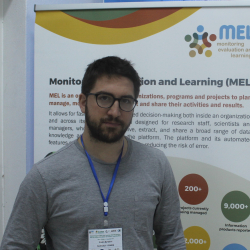
During the training course on "Integrated Crop-Livestock Production for Marginal and Favorable Ecosystem", the participating scientists oversaw the Majidiya site and Muchaggar Experimental Station, evaluating the performance and calculate the carrying capacity of Majidiya. The international event took place on 20th September 2016 and involved 17 scientists and government officials from 14 different countries, in addition to several ICARDA interns.
As part of the visit, the trainees conducted an evaluation of the biodiversity index inside Majidiya plot before proceeding to the Muchaggar Experimental Station, where ICARDA mantains laboratories and small experimental plots to test Salsola vermiculata and other palatable shrub species. The excersise has been carried out with the point-transect method: the resulting value was expectedly low, mainly due to the conditions of the plot during the dry season.
Majidiya is a small site of 5 hectares in the Jordanian Badia, a lowland pasture, traditionally managed land with a semi-nomadic grazing system. ICARDA signed an agreement with local authorities and communities to maintain the site untouched, allowing the interventions on the area to settle. The agreement has not always been respected by the locals, eager to plant barley between the furrows and use the site as pasture, causing the partial degradation of the plot structure and overexploiting it. As a result, the site presented symptoms of overgrazing such as the appearance of Anabasis Syriaca, a non-palatable shrub species.
The restoration of Majidiya has been carried out implementing the Vallerani System, as part of a project for enhancing sustainable fodder production in arid lowland pastures. Vallerani is an integrated system for management of human and natural resources: it consists of a method to work semi-arid land by improving water harvesting and fighting desertification, ultimately restoring the degraded land. The site was cured through micro-catchment water harvesting techniques, such as run-off strips and bunds creating contour ridges. In addition, a Vallerani machine - a plow with an hydraulic arm for intermittent pit excavation along the natural contours of slopes - was used for excavating furrows.
The research conducted on site led to the development of a low-cost Contour Laser Guiding (CLG) system, based on GPS guidance technology, later adapted and implemented in the Vallerani unit. The system enabled the planting of Salsola vermiculata along the furrows, a shrub species very palatable for livestock. This enhanced Vallerani procedure is widely applied in Jordan, restoring thousands of hectares of degraded land as part of the "Badia Restoration Program".
Acknowledgement
The training has been conducted by The International Center for Agricultural Research in Dry Areas (ICARDA) in the framework of the CGIAR Research Program on Dryland Systems (CRP-DS) and funded by the Arab Fund for Economic and Social Development (Arab Fund), with the contribution of Islamic Development Bank (IDB).
CGIAR portfolios & Partners

Keywords
Countries

About the author